
Key Takeaways
- Dementia and sexually inappropriate behavior is a recognized neurological symptom, not a character flaw or a moral failing in the person who has it.
- The behavior traces to damage in brain regions that control judgment and impulse, confusion about identity or setting, or an unmet physical need.
- Calm redirection, routine, and clothing adjustments reduce incidents more reliably than confrontation or punishment.
- Caregivers who witness or manage this behavior carry a distinct, heavier burden, and that burden is clinically documented, not imagined.
- Support exists that does not require you to explain any of this to a stranger in a waiting room.
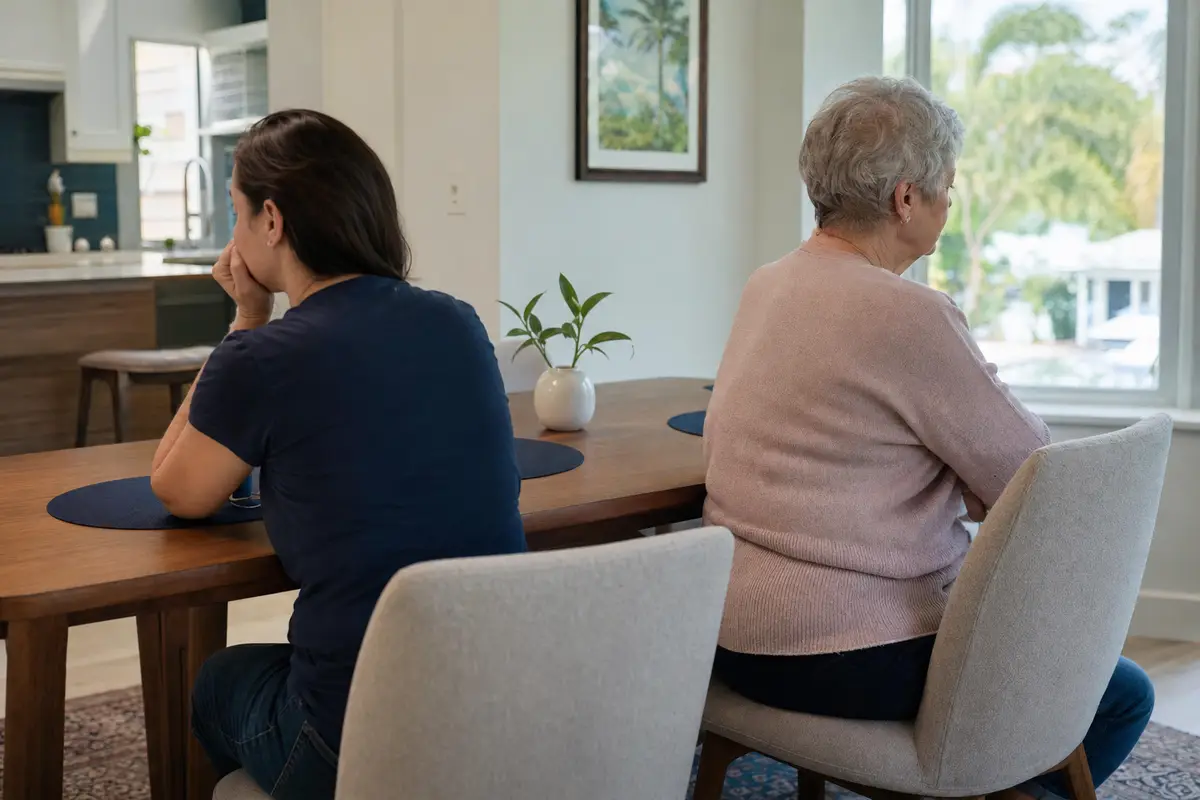
When a parent or spouse with dementia starts undressing in front of guests, touching themselves in public, or saying something sexually explicit to a home health aide, most caregivers freeze. They don’t know whether to laugh it off, apologize, leave the room, or call someone. Dementia and sexually inappropriate behavior is one of the least-discussed symptoms of the disease, and one of the most isolating for the person watching it happen to someone they love.
You are not the only person dealing with this. You are just the only person in your circle talking about it, if you’re talking about it at all.
What this looks like in daily life
It rarely looks like what people imagine when they hear the phrase. It’s a father-in-law who repeats a crude comment to every female nurse who enters the room. It’s a mother who starts removing her clothes at 4 p.m. in the living room, not out of exhibitionism but because she’s hot, disoriented, or trying to get to the bathroom and has lost track of where she is. It’s a husband who propositions his wife’s caregiver, genuinely unaware that anything about the moment is wrong.
The behavior includes explicit language, public touching, undressing, misreading a caregiver’s routine physical contact (helping with bathing, dressing) as something else, or confusing a spouse for someone from decades earlier. It also shows up in smaller, quieter forms: a comment muttered under the breath during a meal, a hand that lingers too long during a hug, a joke repeated word for word every single visit because the person no longer remembers telling it an hour ago.
None of it is planned. None of it reflects the person’s values before the disease. That distinction matters, and it’s worth repeating until it sinks in, because shame drowns it out. Families often describe a strange double grief here: grief for the parent or spouse they knew, and a second, quieter grief for the version of that relationship they now have to manage in public.
The disease produces this behavior through specific, mapped changes in brain structure, not through a loosening of character. Understanding where those changes happen is the first step toward responding to the behavior instead of the person, and it’s also the first step toward forgiving yourself for how hard that response can be to execute in the moment.
What the research shows
Sexually inappropriate behavior in dementia sits inside a broader category clinicians call disinhibition: the loss of the brain’s normal social braking system. It shows up alongside other impulse-control changes, including blunt comments, poor filtering, and wandering. The underlying mechanism is damage to the frontal and temporal lobes, the regions responsible for weighing consequences and reading social context before acting.
This matters because it reframes the question families usually ask. The question is not “why would he do that,” as if the person made a choice from a menu of options. The question is which part of the brain’s control system is offline right now, and what that offline system used to do automatically, without the person ever having to think about it.
Clinical Insight
Behavioral symptoms such as sexually inappropriate behavior place substantial strain on family caregivers, and comparative research confirms that caregivers of older adults with dementia report significantly higher burden and anxiety than caregivers of older adults without dementia (Comparative caregiver study, Kuwait, 2024-25). This elevated strain is not merely emotional discomfort; spousal caregivers followed over 24 months showed roughly one-third developing comorbid anxiety and depressive disorders, with 60% developing at least one of the two (Joling et al., Am J Geriatr Psychiatry, 2015). Managing disinhibited behaviors in cognitively impaired patients also requires adapted therapeutic approaches, since treatment effects are known to be weaker in physically ill or cognitively impaired older patients, pointing toward modified formats and closer coordination with medical care rather than withholding intervention (Pinquart et al., 2007). Given these compounding risks to caregiver mental health, clinicians should actively screen caregivers themselves for anxiety and depressive symptoms when such behavioral disturbances are present (Joling et al., Am J Geriatr Psychiatry, 2015).
Dementia caregiving carries a measurable clinical cost that goes beyond general stress. Comparative research out of Kuwait found that family caregivers of older adults with dementia report significantly higher burden and anxiety than caregivers of older adults without dementia, a pattern consistent with the broader caregiver-burden literature (Comparative caregiver study, Kuwait, 2024-25). A separate two-year study following spousal caregivers of people with dementia found that roughly one-third developed comorbid anxiety and depressive disorders during the follow-up period, and 60% developed at least one of the two (Joling et al., Am J Geriatr Psychiatry, 2015). Behaviors like disinhibition and inappropriate sexual comments fall within the category of difficult dementia-related symptoms that this research links to elevated caregiver anxiety and depression risk.
These numbers describe something many families already feel but rarely say out loud: this specific symptom is not a minor embarrassment to absorb quietly. It is a recognized contributor to the caregiver mental health crisis that dementia produces, and it deserves the same clinical attention caregivers give to medication schedules and fall risk.
The brain damage that produces disinhibited behavior is the same damage that makes the person unable to recognize it as a problem. That gap, between what the behavior looks like and what the person is capable of understanding about it, is why punishment fails as a response and redirection works. A person who cannot recognize the behavior as wrong cannot learn from being told it is wrong. The correction lands nowhere.
What actually helps
The instinct to scold, shame, or sharply correct the person is understandable and backfires. Confrontation escalates agitation, confuses the person further, or triggers a defensive reaction, because the behavior does not come from a place of reasoning you can argue with. The goal shifts from correcting the person to managing the moment.
A few approaches work better:
Redirect, don’t confront. Calmly guide attention elsewhere; offer a task, a snack, a walk to another room. The goal is interruption, not correction. A flat, neutral tone works better than a shocked or angry one, because the person often mirrors the emotional charge in the room even when they cannot follow the content of what’s being said.
Check for an unmet need first. Undressing often means the person is too warm, needs the bathroom, or has uncomfortable clothing. Explicit comments sometimes spike with urinary tract infections, which cause sudden behavioral and cognitive changes in older adults. When the shift is sudden, rule out a physical cause before assuming it is purely psychiatric; our guide on mental symptoms of UTIs in elderly adults covers what that looks like.
Adjust the environment. Clothing that’s harder to remove quickly, a predictable daily routine, and limiting situations that cause overstimulation reduce frequency for some people. Simple changes, like scheduling visitors earlier in the day before fatigue sets in, make a measurable difference for some families.
Separate the person from the disease, out loud, to yourself. This is not your father being who he was. It’s a symptom. Saying that sentence to yourself, even if it doesn’t feel true yet, is part of how caregivers protect their own relationship with the person underneath the behavior.
If the behavior involves another resident or staff member in a facility, or escalates toward anyone’s safety, that’s a conversation for the facility’s clinical team and a licensed mental health provider, not something to manage alone through sheer willpower.
The toll this takes on you
Here’s what rarely gets said: you’re allowed to be exhausted by this specific symptom in a way that’s different from general caregiving fatigue. It carries a layer of embarrassment, grief, and sometimes disgust that caregivers feel guilty even naming. Many caregivers describe feeling trapped caring for an elderly parent long before this kind of symptom appears, and this particular behavior often tips an already heavy load into something closer to caregiver burnout.
If you’ve noticed yourself withdrawing from friends, dreading visitors, or feeling flashes of resentment you didn’t expect, those are common signs of caregiver burnout, not evidence you’re failing. If you’re trying to figure out how you got here, our piece on the stages of caregiver burnout traces how gradual this usually is. And if a sudden change in your parent’s behavior has you wondering what’s shifted, read about what causes sudden extreme fatigue in elderly adults alongside behavioral changes, since physical and cognitive symptoms often move together.
You don’t have to carry this without naming it. Caregiver stress has a clinical name of its own, explained in caregiver stress is also known as, and recognizing it as a real condition, not a personal weakness, is often the first step toward recovering from caregiver burnout.
Naming the condition does not erase the embarrassment that comes with it. It gives you a framework to explain what’s happening to the next person you have to tell, whether that’s a sibling, a doctor, or a therapist. It also gives you language to use with the person’s medical team, so the behavior gets documented as a symptom in the chart rather than brushed aside as an awkward anecdote.
Does dementia and sexually inappropriate behavior mean the disease has gotten worse?
No single behavior proves the disease has advanced. It appears at any stage and reflects which brain regions the disease affects at that moment, particularly the frontal and temporal lobes, rather than how far the disease has progressed overall. Some people never exhibit it; others show it early and it fades; others develop it later, often alongside other changes in judgment or language. Track the behavior alongside memory, mobility, and daily function. A doctor evaluating overall progression needs that full picture, not one symptom in isolation.
Where to find support
If you’re supporting someone through this, start with caring for an elderly parent for the broader picture of what this stage of caregiving involves, and consider a caregiver support group. A room full of people who already understand what you’re describing removes the need to brace for anyone’s reaction. If you’re the one trying to help a caregiver you love, how to support a caregiver is written for you.
For caregivers managing related symptoms like sundowning or trying to understand how to deal with caregiver burnout day to day, or figuring out how to avoid caregiver burnout before it fully takes hold, these resources sit alongside this one. Some caregivers are also managing a parent with longstanding personality difficulties on top of dementia; our guide to the aging narcissistic parent addresses that layered situation directly. And if sleep and agitation patterns are part of what you’re navigating, sundowning explains the late-day symptom cluster many families see alongside disinhibition.
You don’t need a diagnosis, a crisis, or a polished explanation to reach out. You need a Tuesday afternoon free and a willingness to say the thing out loud to someone trained to hear it without flinching.
For related reading, see our caregiver support hub hub and signs your elderly parent needs help.
What this means for you
Pick one thing from this article and do it this week: call a clinician and describe, in plain words, the one incident that has been sitting heaviest on you. You don’t need to have language for it yet. Therapy for caregivers exists for this exact gap, and understanding how long it takes to recover from caregiver burnout sets realistic expectations for your own healing, not just your parent’s care. Better You Therapy is a Florida-licensed mental health practice providing teletherapy statewide and on-site clinical services in Southeast Florida senior-living communities; a clinician meets with you by video, wherever you are, with no referral and no waitlist standing between you and that first conversation.